Curly Hair for Men: The Complete Guide to the Perfect Cut That Won't Ruin Your Curls
Haircuts & Styles11 min read

If you have curly hair and you live or work in the Ramat Gan–Givatayim area, you've probably lived through this exact scenario: you walk into a barbershop, explain that you just want to "tidy it up a little," and walk out with a cut that looks great for a few minutes — until it dries and turns into a puffy, shapeless triangle. You're not alone. This guide is designed to give you, the modern and busy man, the precise tools to get a curly haircut that flatters you, looks professional, and holds up over time.
The Critical Mistake 90% of Barbers Make With Curly Hair (and How to Avoid It)
The biggest and most fundamental problem is that most barbers — even the talented ones — approach curly hair with techniques meant for straight hair. They pull, stretch, and cut the hair while it's wet, in a straight, uniform line. The result? A catastrophe you could see coming. When curly hair dries, every cluster of curls shrinks and springs up to a different height. The straight, precise line the barber created on wet hair turns into holes, uneven lengths, and an overall look of uncontrollable frizz. The cut loses all shape, and the curls lose their definition. The goal of this guide is to arm you with the knowledge to identify the right barber, communicate with him effectively, and make sure you never again walk out feeling like your curls got ruined.
Instead of working with the curl, many barbers fight against it. They reach for thinning shears in an attempt to remove volume, but in practice they only damage the curl's structure and create springy, frizzy ends. They cut according to a fixed geometric pattern instead of sculpting the hair to its natural shape. This approach ignores the fact that every curl is an independent entity with a "personality" of its own. The key is to understand the fundamental differences in hair structure, and to demand a technique that respects them.
The Anatomy of a Curl: Why Your Hair Demands Special Treatment
To understand why curly hair needs to be treated differently, you have to understand its basic biology. It's not just a matter of appearance — it's a physical structure that is completely different from straight hair. Two main factors are at play:
- The shape of the hair follicle: In straight hair, the follicle (the root from which the strand grows) is round and symmetrical. This causes the strand to grow straight out. In curly hair, by contrast, the follicle is oval or asymmetrical. That flattened shape "forces" the strand to grow at an angle, which creates the characteristic curl. The more oval the follicle, the tighter the curl will be.
- A tendency toward chronic dryness: Our scalp secretes a natural oil called "sebum," whose job is to travel down the strand, nourish it with moisture, and protect it. In straight hair, that journey is short and quick. In curly hair, the coiled, zigzag structure makes it very hard for the natural oils to reach the ends. The result is a scalp that can be oily, while the ends of the hair stay dry, brittle, and prone to frizz.
Beyond that, the outer layer of the strand, the "cuticle," is built like shingles on a roof. In curly hair, because of the twists, those "shingles" tend to lift up more, which lets moisture escape easily and gives the hair a dull look. An incorrect cut, especially with thinning shears, damages this cuticle layer, weakens the hair structure, and creates long-term damage that leaves the curls weak and lifeless.
Wet vs. Dry Cutting: Which Method Is Right for You?
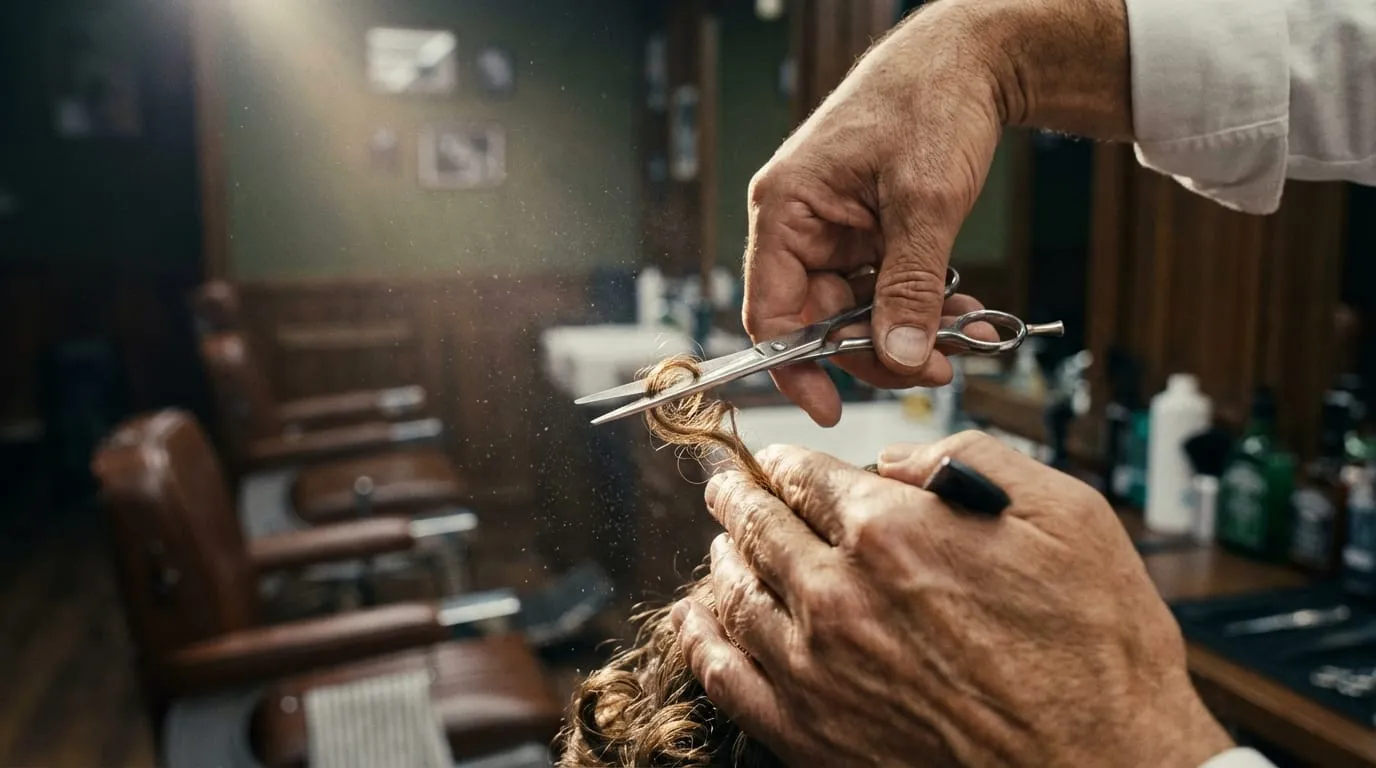
One of the most decisive choices that determines the fate of your haircut is whether to cut the hair wet or dry. For curly hair, this choice is critical, and the answer is almost always clear-cut. Let's break down the pros and cons of each method.
Cutting on Wet Hair
- Advantage: Most barbers find it easier and more comfortable to work with wet hair. It combs easily, which makes it possible to create clean, technically precise cutting lines. This method is faster and is familiar to the vast majority of professionals.
- Critical disadvantage: This disadvantage cancels out every possible advantage. When curly hair is wet, it loses its natural shape and stretches — sometimes adding as much as 30% to its length. The barber cuts it in this stretched state. When the hair dries, it returns to its natural state and shrinks unevenly. Curls in different areas of the head shrink at different rates, and the result is a haircut with "holes," uneven lengths, and an overall messy, unprofessional look.
Cutting on Dry Hair (the Recommended Method)
- Advantage: This is the only way to see the hair in its natural state. The barber can see exactly how each curl "sits," where it tends to fall, and how clusters of curls work together. This allows him to sculpt the cut curl-by-curl, to work with the natural shape of the hair rather than against it, and to create a structure that holds up even after washing. The result is precise, personalized, and works with your hair, not against it.
- Disadvantage: The method requires expertise, patience, and a very high level of skill from the barber. Not every barber knows how, or is willing, to work this way. It may take more time and sometimes cost more, but the result fully justifies it.
Bottom line: For a curly-haired man looking for a professional, precise, and consistent result, a dry cut is the Gold Standard. It's the best investment you can make in your hair.
The Exact Script: What to Tell Your Barber in Ramat Gan to Get What You Want
Knowledge is power, especially when you're sitting in the barber's chair. Instead of hoping for the best, you need to manage the process. This section is a practical checklist that will ensure you get exactly what you want from your barber, whether he's in the Bursa district or in Marom Naveh.
- Step 1: The research (before booking an appointment): Don't choose a barber at random. Pick up the phone and ask two key questions: "Does your shop specialize in haircuts for men with curly hair?" and "Do you do cuts using the dry method?". If the answer is hesitant, evasive, or you sense a lack of confidence, simply say thank you and move on to the next shop. A barber who specializes in curls will say so with pride and confidence.
- Step 2: The arrival (haircut day): Don't show up to the shop with your hair tied up in a hat or right after a workout. Come with your hair dry, clean, and styled exactly the way you like it day-to-day (with your usual products). This lets the barber see your natural curl pattern, understand how you arrange it, and see its natural fall. This is the most important starting point for him.
- Step 3: The communication (in the chair): Use correct, precise terminology. Instead of saying "take a little off," try sentences like: "I want to keep the overall length but add shape and volume on top," "It's very important to me to avoid thinning shears completely — they create frizz for me," or "I want a cut that works with the natural shape of my curls, not one that tries to straighten them."
- Step 4: Visual aids: "A picture is worth a thousand words" is especially true here. Bring 2–3 photos of men with a curl type and face shape similar to yours. It doesn't mean you'll get the exact same cut, but it gives the barber a clear visual direction and reduces gaps in communication.
- Step 5: The confirming question: Before the scissors touch your hair, ask one simple but critical question: "Can you briefly explain what you're planning to do and how it will suit my hair type?". A professional barber will be happy to explain the process, which will give you peace of mind and confirm that you're both on the same page.
At-Home Maintenance: How to Keep the Cut Sharp and the Curls Healthy
A great haircut is only 50% of the equation. For your curls to look their best between cuts, you need a proper at-home grooming routine. It's not as complicated as it sounds, and it comes down to a few simple key principles.
1. Washing and Conditioning
The first step is to throw out your regular shampoo. Most supermarket shampoos contain sulfates (SLS/SLES), aggressive detergents that are great for washing dishes but destructive for curly hair. They strip the hair of the few natural oils it has, leaving it dry, frizzy, and lifeless. Do yourself a favor and switch to a sulfate-free shampoo. In addition, never skip conditioner. After every wash, use a generous amount of a moisture-rich conditioner, focusing on the ends. Let it sit for a minute or two before rinsing to allow the nourishing ingredients to penetrate the strand.
2. Styling on Wet Hair
This is the most important rule in styling curls: apply styling products while the hair is still very wet, almost dripping. Why? Because in that state, the strand's cuticle layer is open. Applying a moisturizing cream, gel, or mousse to wet hair "locks" the moisture inside the strand, defines the curl, and prevents frizz from forming as the hair dries. If you wait for the hair to start drying, you'll simply be applying product to hair that's already starting to get frizzy, and the result will be significantly worse.
3. Drying Correctly
Your regular bath towel is the enemy of curls. Its coarse fibers create friction, break up the curl's structure, and cause frizz. Instead, use the "plopping" technique: after applying your styling products, use an old cotton T-shirt or a microfiber towel to gently "scrunch" the curls upward toward the scalp and soak up the excess water. If you're in a hurry and using a hair dryer, you must use a diffuser (the round attachment with the "fingers") on low heat and low airflow. The diffuser distributes the heat gently and preserves the shape of the curls.
Frequently Asked Questions (That You Didn't Dare Ask Your Barber)
How often do I need a haircut to keep the shape?
The recommended frequency for men with curly hair is between 6 and 12 weeks. The wide range comes from differences in the type of cut and in individual growth rate. Shorter cuts, especially ones with a sharp fade on the sides, will require more frequent maintenance (every 6–8 weeks) to keep the lines clean. Longer cuts can hold up for 10–12 weeks or even more, as long as you keep the ends healthy.
Is it okay to use clippers on the sides?
Absolutely. Using clippers to create a fade on the sides and the back of the head can create a very modern, interesting contrast with the volume and texture of the curls on top. That said, it's critical that the barber knows how to create a gradual, professional blend between the short part and the long part. A sharp or imprecise transition will create an unflattering "mushroom" or "bowl" look.
What about thinning shears? My barber always wants to use them.
This is a red warning light. Thinning shears are the biggest enemy of curly hair. They don't actually "thin" the volume in an aesthetic way. Instead, they cut individual strands at different lengths within a curl cluster, which breaks up the natural curl pattern, creates springy ends that can't be controlled, and produces a tremendous amount of frizz. Ask your barber, assertively but politely, to avoid them entirely. A barber who specializes in curls knows how to remove volume and create shape through proper cutting techniques, with no need for this destructive tool.
Are there specific haircuts recommended for curly hair?
Yes, there are several styles that work great with curly texture. Some of the most popular and successful are: the "Curly Undercut" or the "High Top Fade," in which the sides are very short and the top stays long and full of defined curls. Another style is a medium-to-long length cut with a subtle taper that creates a rounded, flattering shape, preventing the "triangle effect." The key is to choose a cut that suits your face shape and your specific curl type.
In conclusion, curly hair isn't a problem — it's an asset. With the right knowledge, precise communication with your barber, and a simple grooming routine, you can turn your hair into a source of confidence and a unique look. Stop fighting your curls and start working with them. For anyone who wants to dive even deeper into this world, we recommend visiting the website of the international curly hair community, a leading source of information in the field.
Want this on your own head?
Our team at 7 Rashi St, Ramat Gan is waiting for you — booking online takes less than a minute.