
The Fade Haircut in Ramat Gan — The Complete Guide
The fade isn't just another haircut — it's the foundation almost every modern men's look is built on: a smooth, clean transition from short sides into a full top, without a single broken line along the way.
How much it costs: A men's haircut at our Ramat Gan shop starts at ₪90 (includes consultation and a personal fit). Fade, skin fade and taper are all included in the men's haircut price; adding a beard or a scissor cut is priced separately. See the full price list
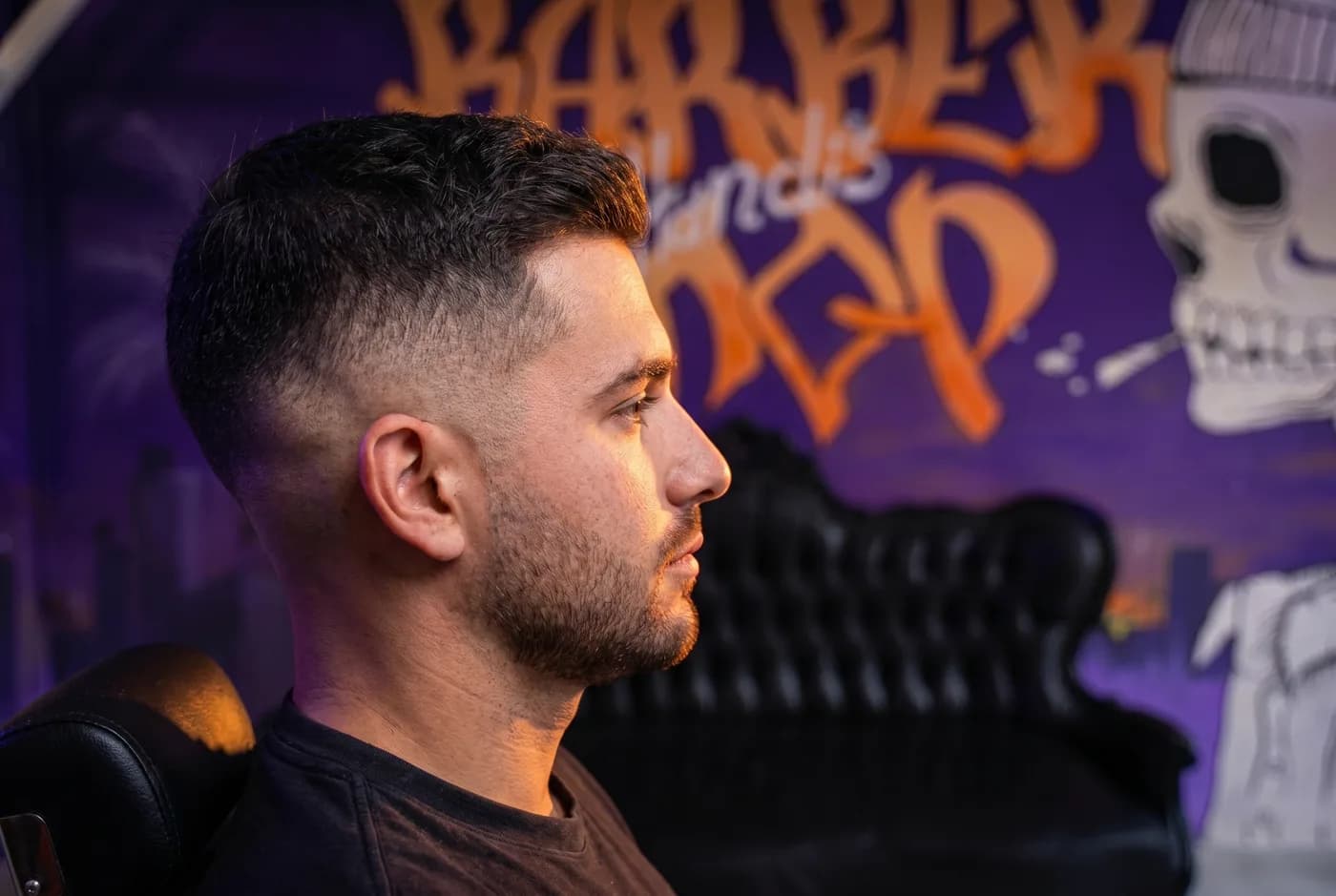
What is a Fade?
A fade (from the idea of "fading" out) is a graduation technique in which the hair gets progressively shorter as you move toward the nape and the ears, until it melts into the tiniest stubble or into the skin itself. The graduation is built around the entire head — a full 360 degrees — using an orderly progression through clipper guards: a 3 up top, down through the 2 and the 1, all the way to zero at the bottom. Between each of these "levels," the barber blurs the connecting line with clipper-over-comb work and delicate cutting motions, so the eye can never spot where one length ends and the next begins.
The fade was born in mid-century American military barbershops, got a second life in the hip-hop culture of the '80s and '90s, and has since conquered the world — today it's the default at virtually every serious barbershop. The reason is simple: a fade is a frame, not a picture. It doesn't dictate what happens on top — a lifted quiff, a textured crop, free curls or a slicked-back pomp — but gives each of them a clean, precise base that highlights the style instead of competing with it. Here in Israel, too, it has become synonymous over the past decade with a professional men's haircut — so much so that for many clients the word "fade" has all but replaced the word "haircut."
What separates a great fade from a mediocre one? The transition. In a professional fade you can't point to the spot where the length changes — you see an even shadow that climbs gradually, with no "steps," no dark patches and no broken lines. To get there, the barber works in layers, checks the graduation from every angle and cross-references in the mirror before moving on to the next stage. And when it's done right, a fade does something that's hard to put into words: it frames the face, reveals the jawline and projects sharpness before you've said a single word. This is also the moment to bust a common myth: a fade isn't necessarily a "short haircut" — you can pair it with a full pomp, heavy curls or slicked-back length; the graduation only governs what happens on the sides and the nape, and everything else is wide open.
Who does the Fade suit?
Almost everyone — and that's not a cliché. A fade works on straight, wavy and curly hair, and suits most face shapes when you pick the right height: round faces benefit from a high fade that optically stretches the profile; longer faces look more balanced with a low fade that keeps volume on the sides; and fine hair actually loves the contrast, which creates the illusion of thickness and density up top. Age doesn't play a role here either — boys before their bar mitzvah and men in their sixties-plus both sit in our chair, and each one walks out with a different version of the same idea. Working in a conservative environment? A subtle low fade will look completely neat and professional. Want presence? A high fade or skin fade will make the statement for you. And before you commit, it's worth factoring in maintenance: if a refresh every two to three weeks doesn't scare you, every height is on the table; if you prefer more spaced-out visits, a low fade will forgive you far more than a skin fade will.
Fade variations worth knowing
Low Fade
The graduation starts low, right above the ears and the nape, leaving most of the sides full. This is the most subtle, classic version in the family — neat enough for any business meeting, and a great entry point for anyone getting a fade for the first time. Bonus for beard growers: a low fade connects to a full beard in the most natural way, because it keeps the continuity between hair and face.
Mid Fade
The balance point of the entire fade world: the graduation starts around the temples — high enough to be seen, restrained enough that it doesn't take over the look. It's the most requested variation in our chair, it flatters most head shapes, plays well with almost any style up top and holds up nicely even as the hair starts to grow back.
High Fade
Here the graduation climbs high, close to the crown line, creating a strong contrast between exposed sides and a full top. The result is dramatic and eye-catching: the face is revealed, the gaze is drawn upward, and whatever you've done with the hair on top gets center stage. An excellent choice for anyone after a statement — and for round or square faces that benefit from the lengthening effect.
Skin Fade
The sharpest version of them all: the graduation drops all the way down to the skin, using a dedicated shaver, and the transition from smooth skin to full hair is the true test of any barber's skill. Because it's a whole world in itself, we've devoted a separate page to it — all the details are waiting for you in our full skin fade guide.
Burst Fade
The variation gaining momentum in recent years: the graduation curves around the ear in an arc that resembles a sunburst — short and deep by the ear, widening up and back — while the nape stays fuller than in a regular all-around fade. Thanks to that, the burst pairs beautifully with styles that leave length in the back, from crops to modern mullets. Looking for a fade that doesn't look like everyone else's? This is a direction worth considering.
Skin fade vs. fade vs. taper vs. zero
| Style | How short at the sides | Contrast | Upkeep frequency | Best for |
|---|---|---|---|---|
| Skin fade | Down to bare skin (zero) at the bottom | Maximum — sharp and dramatic | Every 1–2 weeks | Anyone who loves a clean, sharp look and is up for frequent touch-ups |
| Regular fade | Graded to a low guard (1–2), not to skin | Medium–high | Every 2–3 weeks | Most men — a balance of sharpness and flexibility |
| Taper | Gentle shortening at the temples and nape only | Subtle and understated | Every 3–4 weeks | Conservative settings, or anyone wanting a tidy look that lasts |
| Buzz / zero | One even short length all over | None — uniform length | Every 1–2 weeks (hairline) | Minimal upkeep and an understated look |
The Fade from our chair
Real client results — this is how it looks when you leave our shop in Ramat Gan.


How to keep it sharp between cuts
The simple truth: a fade is a haircut that looks incredible — and grows out. Hair grows at an even rate all over the head, so the very contrast that makes a fade what it is keeps fading away: after a week or two the transitions still look good, and around the third week the graduation is already asking for a refresh. The accepted recommendation in the barbering world is to renew every 2–3 weeks for a tight fade — that way you stay in the "just got a haircut" zone all the time. Between visits the home routine is simple: a light towel dry, a small amount of matte product on top — clay for thick hair, a light paste or cream for fine hair — and nothing more. A precise fade doesn't need help to look neat. And if you want to stretch the time between cuts, a quick mid-way refresh of the neckline keeps the look clean into the third and fourth week.
Two more small habits that pay off: wash with lukewarm rather than scalding water — high heat dries out the scalp exactly in the short, exposed areas — and stick to a clean towel for your head. And when it comes to product, less is more: too much wax or gel weighs the top down, closes off the volume and collects dust through the day. Start with a pea-sized amount, warm it between your palms, work it through the hair — and only add more if something's missing. It doesn't work the other way around.
The Fade in Ramat Gan
If there's one thing Handi's Barbershop in Ramat Gan built its name on, it's the fade. At our place on Rashi St. 7 the graduation isn't a step in the haircut — it's the craft itself: we study your head shape, choose the transition height together, and build the blend layer after layer until it's perfect from every angle — including the back, where you can't see and others can. We work by appointment only: pick a time on Calmark, come in, and walk out with a fade that justifies the visit. And if you're still not sure which height to go for — come in with the question. That's exactly our job.
Fade — questions & answers
How long does a fade haircut last?
At its sharpest — about a week and a half to two weeks, depending on your growth rate and the graduation height. The tighter and closer to the skin the fade is, the faster the regrowth shows. Most of our clients refresh every 2–3 weeks to stay at their peak the whole time.
How do I know which fade height suits me?
Rule of thumb: longer faces — a low fade that keeps volume on the sides; round faces — a high fade that stretches the profile; on the fence — a mid fade, which flatters almost everyone. But the safest way is to decide in the chair: we look together at your head shape, hairline and the style you like, and the decision becomes clear within a minute.
Does a fade work with curly hair?
It works beautifully. The short sides take down volume exactly where curls tend to "puff out," and the contrast brings out the texture on top. A defined curl over a clean fade is one of the strongest looks out there — and one of the most requested at our shop.
What should I tell the barber to get exactly the fade I want?
Three details are enough: the graduation height (low / mid / high), how short at the lowest point (a 1? a zero? down to the skin?), and what happens on top. A photo from Instagram always helps — and if something won't work on your hair type, we'll tell you honestly and suggest an alternative that flatters you more.
How much does a fade haircut cost?
The fade is included in our men's haircut service, and the price is set by the service you choose — it's shown transparently when you book on Calmark, before you even confirm. You can also take a look at the price list on the site.
What's the difference between a fade and an undercut?
In an undercut the sides are cut to one uniform length, with a clear separation line from the top — no gradual transition. In a fade, by contrast, the whole point is the graduation: the length changes continuously from bottom to top. Both shorten the sides, but a fade looks soft and polished, while an undercut is graphic and bold. You can also combine the two: an undercut that's faded at its base gets the best of both worlds.
Related styles worth knowing
Each style gets its own guide here — and if you want the real thing, the service page is waiting.
Want a Fade? Let's talk
Booking on Calmark takes less than a minute — pick a service and time, and arrive relaxed at 7 Rashi St, Ramat Gan.