Uneven Fade? The Complete Guide to Spotting It, Fixing It, and Talking to Your Barber
Haircuts & Styles9 min read

Got a Fade That Looks… "Off"? You're Not Imagining It.
You walked out of the barbershop feeling fine, but after a shower and a second look in the mirror, something just doesn't sit right. That feeling of having gotten an uneven fade is all too familiar, and you're not alone. This isn't about being nitpicky; a precise haircut is part of your professional and personal image, especially in a fast-paced setting like Ramat Gan. The good news is that this is a common, understandable problem, and most importantly — a fixable one. This guide is here to give you clear tools to identify the issue, and above all, the confidence to ask for the fix you deserve.
The Checklist: 5 Sure Signs Your Fade Is Uneven
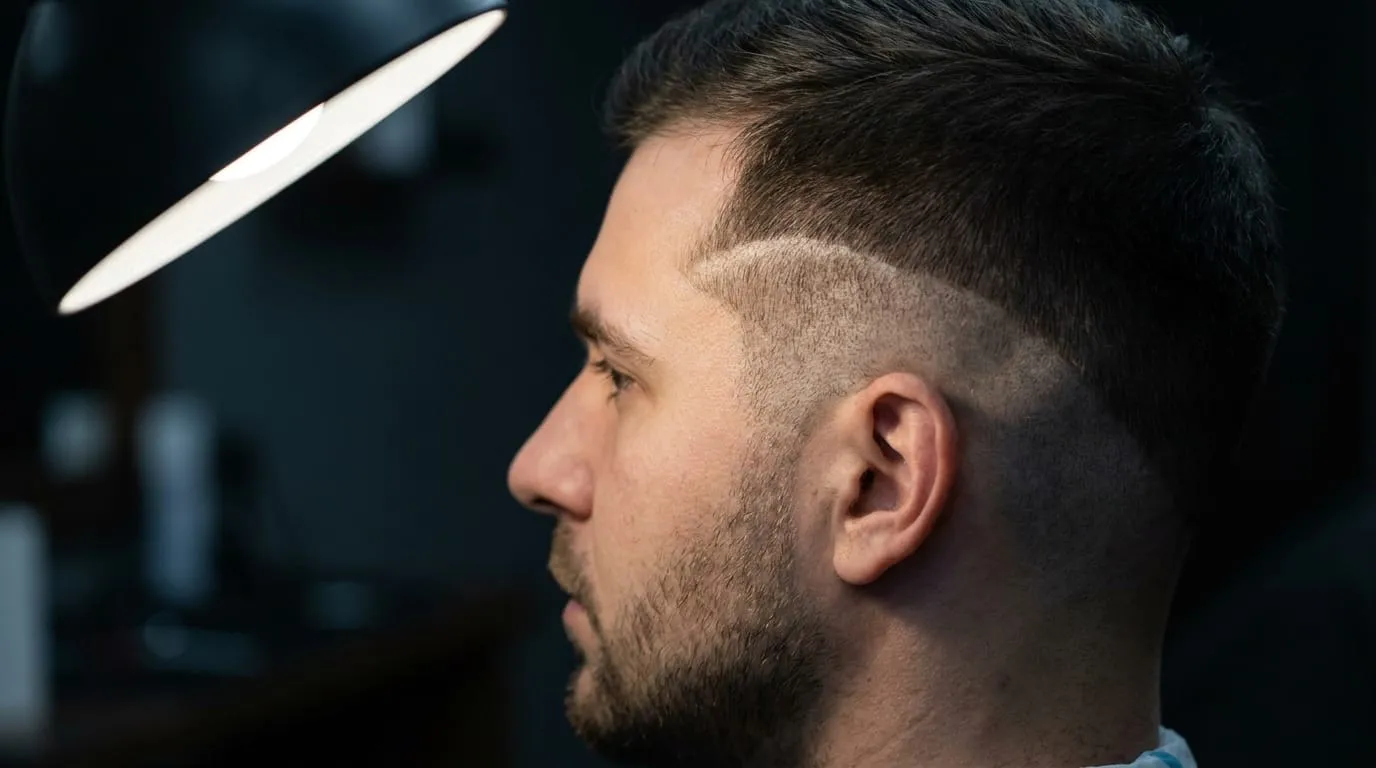
A quality fade, or a professional hair gradient, is the art of transitions. The goal is to create a smooth, gradual, and harmonious blend from short hair (sometimes down to the skin) to a longer length on the top of the head. The fade haircut technique demands a lot of precision and a sharp eye for detail. When that precision is missing, the result looks unprofessional. Stand in front of a well-lit mirror and check the following points:
1. Lines That Aren't Clean or Are Crooked
The framing of the cut is critical. Look at the lines around your ears and along your neckline. Are they sharp, straight, and clean? A sloppy, crooked, or undefined outline is the first and clearest sign of imprecise work. This is the finishing touch of the haircut, and if it isn't perfect, it hurts the overall look even if the fade itself is reasonable.
2. An Abrupt Transition Instead of a Gradual One ("Steps")
This is the classic flaw of an amateur fade. Instead of a soft, imperceptible transition between different hair lengths, you see a clear "jump" — a horizontal line or band separating a dark area from a lighter one. It looks like a step in the hair and completely breaks the illusion of a smooth gradient. If you can point to a specific spot where the fade "breaks," it's a sign the fade needs a fix.
3. Lack of Symmetry Between the Sides
A good haircut should look balanced from every angle. Stand up straight in front of the mirror and look at both sides of your head. Does the fade start at the same height on both sides? Is the shape of the gradient above the ears identical? Often, an asymmetrical men's haircut is the result of rushed work. A slight imbalance can create the illusion that your head is crooked, and it's a flaw that's relatively easy to spot and fix.
4. Dark or Light Patches ("Clouds")
Run your hand over the faded area. Is the texture uniform? Now look in the mirror again. Do you notice areas that appear darker or lighter than the rest of the fade, with no logical reason? These "clouds" or "patches" indicate that the barber didn't pass over the area evenly with the clippers, or used the wrong guard inconsistently. The result is a blotchy, unclean look.
5. The Fade Is Too High or Too Low for Your Head Shape
Not every type of fade suits everyone. A high fade can elongate a round face, while a low fade may be more flattering for an oblong head shape. If you chose a particular type of fade but the final result looks out of proportion to your skull structure — for example, the fade climbs too high and exposes bumps on the scalp — it's a sign the cut wasn't tailored to you personally. A professional barber should advise you on this in advance.
The Conversation Script: How to Ask for a Fix Confidently (and Without Drama)
This is the part that intimidates many men, but it's simpler than it seems. The key is the right approach: your goal is collaboration toward a better result, not starting a confrontation. Professional barbers want happy customers who come back, and most will be glad to fix work that didn't meet their standards. Here's a simple, effective three-step process, including exact phrasings to help you get what you want.
The most important rule: don't accuse, describe. Instead of saying "you ruined my hair" or "you did a bad job," try an objective, descriptive approach. For example: "I feel like the transition here is a little abrupt, could we maybe soften it?" or "It looks to me like the line at the neckline isn't completely straight, could we straighten it?". This approach invites a solution instead of defensiveness, and the result will be significantly better.
-
Step 1 – Timing: Don't wait too long. Reaching out to the barbershop within 24–72 hours after the haircut is the most accepted and sensible window. After that, the hair already starts to grow out, making the fix harder and the diagnosis less clear. Call, briefly explain the situation, and set a time to come in. Most professional places will fit you in for a quick fix without delay.
-
Step 2 – The Approach: Start the conversation in a calm, polite, and positive tone. You can open with a compliment about something you did like in the haircut. For example: "Hey, thanks for the cut yesterday, the top came out great. I noticed something small on the sides that I'd like to check if we can sort out." An approach like this immediately lowers defenses and makes it clear that you're not coming to complain but to collaborate.
-
Step 3 – The Exact Terminology: Use the terms you identified in the checklist. This shows that you know what you're talking about and makes your request specific and easy to act on. There are guides on communicating effectively with your barber that emphasize the importance of precision. Here are a few examples:
-
Instead of: "I have a hole in my hair," say: "I see an area here that looks a bit darker, I think it's a small 'patch.' Could we even it out?"
-
Instead of: "The fade is crooked," say: "I feel like there's a slight lack of symmetry between the right and left sides, could we match the height of the fade?"
-
Instead of: "I have steps," say: "The transition here feels a bit too sharp to me, could we blend the line to create a more gradual look?"
-
Instead of: "The lines in the back are terrible," say: "Could we sharpen the outline at the neckline? I feel like it isn't completely clean."
Prevention Is the Best Fix: How to Make Sure It Doesn't Happen Again
After you've fixed the current fade, the goal is to avoid this situation in the future. Ultimately, most mistakes stem from poor communication or the wrong choice of professional. The next time you go in for a haircut, follow these rules to make sure you get exactly what you want.
- Bring a reference photo: A picture is worth a thousand words, especially at the barbershop. Find a photo of a haircut you like, on someone with a head shape and hair type similar to yours. But don't stop there — use the photo as a starting point for a discussion. Ask the barber: "Does this haircut suit my head shape? Will my hair type allow me to get this result?"
- Choose a barber based on recommendations and specialty: Not every barber is a fade artist. Some specialize in classic cuts, others in color, and others in fades. Look for recommendations from friends or in local groups specifically about a "great barber for fades in Ramat Gan." Check the barbershop's Instagram page — the pictures speak for themselves.
- Have a consultation before the clippers turn on: Don't let the barber start working before you're a hundred percent sure he understood you. Explain exactly which fade height you want (low, medium, high), how you want the outlines (natural or sharp), and the desired length on top. Make sure he repeats the main points back to confirm you understood each other.
- Don't be afraid to gently speak up during the haircut: If you see something that bothers you mid-work, it's better to say so right away. It's far easier to fix a fade that's still in progress than to try to recreate it after everything's done. A polite remark like "Could we just check the symmetry before continuing?" can save a lot of heartache.
Questions & Answers
Do I have to pay for a haircut fix?
In the vast majority of cases, the answer is no. A professional, reputable barbershop sees a fix as part of its service and responsibility. If you reached out in time (2–3 days) and in a respectful manner, they'll fix their work at no extra charge. It's in their interest to keep you as a satisfied customer. If a barbershop demands payment to fix a clear mistake of its own, that's a red flag about its level of professionalism.
How long after the haircut is it legitimate to ask for a fix?
The accepted rule of thumb in the industry is between 24 and 72 hours. This is the window in which the haircut is still "fresh" and any flaw is a direct result of the work that was done. You can stretch it to a week at the most, but beyond that it starts to become problematic. The hair grows, the shape of the cut naturally starts to change, and it becomes harder to distinguish between a mistake in the haircut and natural growth.
What should I do if the barber refuses to fix it or I no longer trust him?
This is an unpleasant situation, but it happens. If the barber refuses or you've simply lost trust in him (and rightly so), the best option is not to argue. Sometimes, the damage done by a needless argument is greater than the cost of a new haircut. In a case like this, it's advisable to "absorb" the cost, look for another barber with a proven reputation for fixing haircuts, and go to him. See it as an important lesson and an investment in choosing the right professional next time. The ultimate goal is to look good and feel good about your hair, not to win an argument.
Ultimately, the ability to spot an uneven fade and the knowledge of how to communicate it to your barber are tools that empower you as a customer. You don't have to settle for a less-than-perfect haircut. With the right approach, professional knowledge, and the confidence to ask for what you deserve, you can ensure that every visit to the barbershop ends with a sharp, clean, and precise result — exactly as you expect.
Want this on your own head?
Our team at 7 Rashi St, Ramat Gan is waiting for you — booking online takes less than a minute.