First Haircut with a New Barber: The Complete Guide to Perfect Communication
Haircuts & Styles11 min read

You've made the decision: you're going to a new barber. Whether you've just moved to Ramat Gan or you're simply looking for an upgrade, that moment when you settle into an unfamiliar chair can come with a little anxiety: how do you explain exactly what you want so you don't walk out disappointed? The simple truth is that a great haircut is 90% communication and 10% execution. This guide is designed to give you — the modern, busy man — the precise tools to turn every first haircut with a new barber into a success, with no wasted time and no ambiguity.
Before You Sit Down: 3 Prep Steps for the Perfect Haircut
The success of your haircut starts before you even walk into the shop. Showing up prepared won't just save you precious time — it will also maximize the chances that you walk out looking exactly the way you imagined. Instead of hoping for the best, take control of the process with three simple, effective steps.
- 1. Gather references (photos): Don't say "the usual, just a bit shorter." The word "short" is completely subjective. The best way to bridge that gap is with photos. Search Pinterest or Instagram for 2-3 photos of the haircut you want. It's important to find photos of people with a hair type and face shape similar to yours, and where possible, from a few different angles (front, side, back). This gives the barber a clear visual starting point.
- 2. Self-assessment: Take a minute to think about your hair and your past haircuts. What's your hair type? Is it fine and flat, thick and full, straight or curly? What did you like about your last haircut? And just as important — what didn't you like? Maybe the fade was too high, or the fringe was too short. The better you understand your raw material and your preferences, the more precise a message you can convey.
- 3. Define an overall goal: Beyond the technical details, what vibe are you going for? Do you need a sharp, polished look for business meetings on the trading floor? Or maybe a relaxed, textured style for the weekend? Use words like "clean and professional," "loose and natural," "sharp and crisp." Defining the goal helps the barber understand the overall direction and tailor his technique accordingly.
The Barber's Language: How to Precisely Describe the Haircut in Your Head
To get exactly what you want, you need to learn to speak the language. Knowing the professional terms will ensure your instructions are perfectly clear and prevent misunderstandings. Instead of leaving room for interpretation, you'll be able to give precise directions. Let's break the haircut down into its three main components and learn the right words. If you want to go deeper, there's a full barbering terminology guide online that can help.
1. The Sides and Back (The Fade/Taper)
This is the most significant part of most modern men's haircuts. The fade is the gradual transition from very short hair (sometimes down to the skin) to longer hair on top. To explain what you want, use the following terms:
- Numbers: The numbers on the clipper (0, 1, 2, 3, etc.) indicate the length of the guard that attaches to it, and therefore the length of hair left behind. A lower number = shorter hair. "Zero" (0) is very close, almost a shave. "One" (1) leaves about 3 mm, and so on.
- Type of fade: A Low Fade starts just above the ear and low at the nape. It's subtle and conservative. A High Fade starts higher up on the sides of the head, often around the temples, creating a sharper, more dramatic look. A Mid Fade is a balanced compromise between the two.
- Taper vs. Fade: The terms are close but different. A "fade" usually goes down to a very short length (0 or 0.5). A "taper" is a gentler graduation where the hair stays slightly longer at its lowest point.
Example sentence: "I want a low fade that starts at a 0.5 and gradually goes up to a 2 on top, with a clean blend into the top."
2. The Top (The Top)
This is where you define the character of the haircut. It's important to describe both the length and the texture you're after.
- Length: Instead of saying "trim a little," be specific. Use your fingers to show how much you want taken off, or specify a length in centimeters ("take off about a centimeter and a half"). If you're not sure, ask to "just take off the dead ends to freshen it up."
- Texture and style: Do you want the hair to look uniform or intentionally messy? Use terms like: "with texture" or "layered" to ask for a less uniform, more lively look. "Straight line" suits short, polished cuts.
- Styling direction: Explain to the barber how you usually style your hair. "I comb it to the side," "I spike it up," "I push it all back with product." This will help him tailor the cut to the way you style it day to day.
Example sentence: "Up top, leave enough length so I can comb it to the side, but take off about a centimeter and add some texture so it doesn't look flat."
3. The Neckline and Sideburns (The Neckline & Sideburns)
A small detail with a big impact on the overall cleanliness of the cut. The neckline can be:
- Squared / Blocked: Creates a sharp, defined look, but requires more frequent maintenance because regrowth shows on it quickly.
- Rounded: Rounded corners that create a softer look.
- Natural / Tapered: The natural line of your hair, gently graduated. This is the style that holds up the longest and looks the most natural as the hair grows back.
As for the sideburns, simply specify the desired length (to the middle of the ear, to the top of the ear) and the shape (straight or pointed).
Example sentence: "A natural, loose neckline please, and straight sideburns that come down to the middle of the ear."
The Conversation in the Chair: Managing an Effective Dialogue During the Haircut
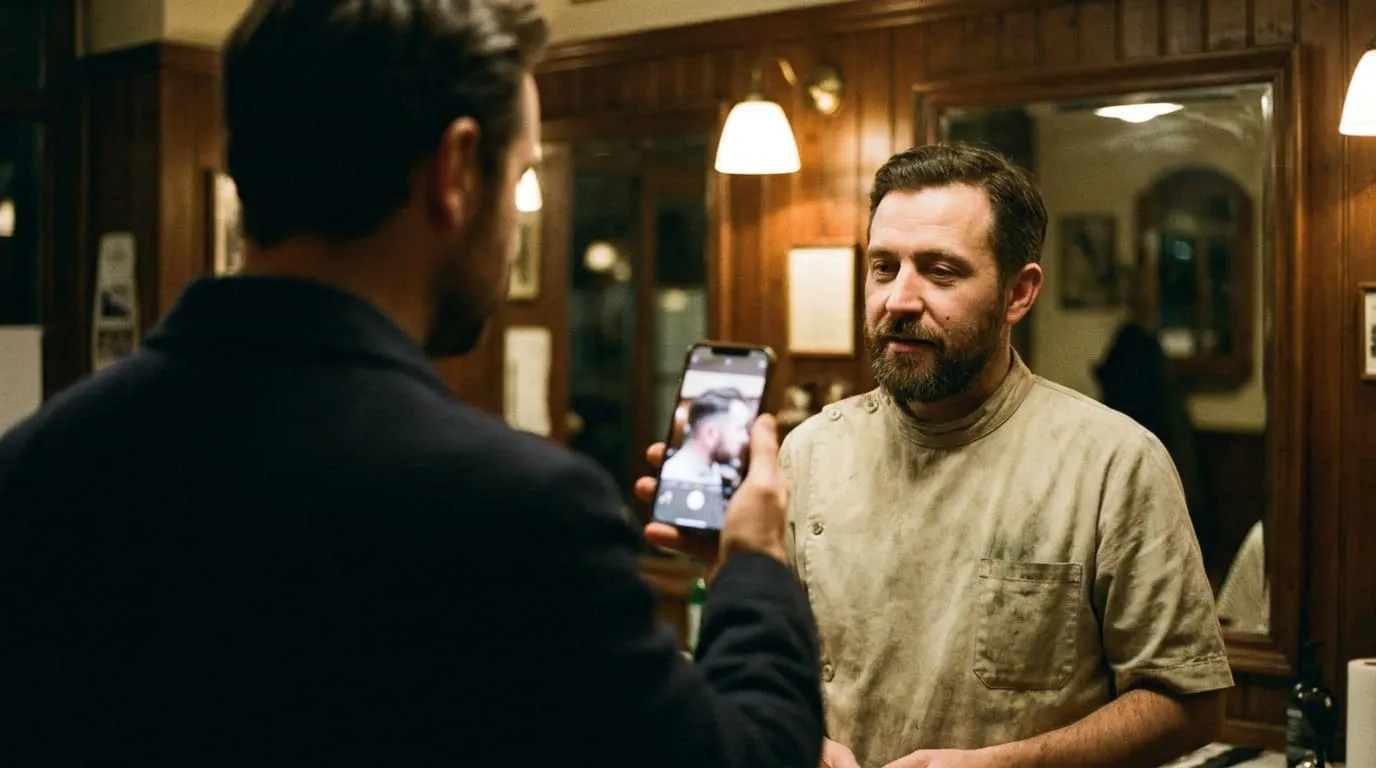
Preparation is critical, but the communication doesn't end there. A haircut isn't a monologue — it's a dialogue. A professional barber wants you to be happy, and he'll be glad to get feedback from you along the way. Instead of sitting quietly and hoping for the best, manage the process actively and confidently. Here's how to do it right, step by step.
- Initial consultation: This is the most important moment. Before the clipper touches your hair, show the photos you gathered. Explain in your own words, using the terms we've learned, what you want to achieve. Then, pause and ask the most important question: "What do you think? Will this suit my hair type and face shape?". This question opens the door to the barber's expertise. Maybe he'll suggest a small change to the fade that better fits the shape of your skull, or recommend a different length on top that's more flattering. Listening to his professional advice can elevate the final result.
- Checkpoints: You don't have to wait until the end to voice an opinion. Don't be afraid to politely step in. Ask the barber to pause for a moment after a key stage — for example, after he's finished the fade on one side and before he starts on the top. Say something like: "Can I take a quick look in the mirror before we move on to the top?". This lets you confirm the direction is right and request small corrections in real time, while everything is still fixable. That's far more effective than complaining at the end when the damage is already done.
- Questions about maintenance and styling: Toward the end of the haircut, when the barber starts styling your hair, this is the perfect time to learn. Ask him: "What product are you using?", "How can I achieve this look on my own at home?", "How much product should I use?". Asking these questions won't just help you recreate the great look day to day — it also shows the barber that you care, that you appreciate his work and see him as a professional. It builds a good relationship for next time.
Pro tip: Your phone is a tool of the trade. After you've shown the barber your reference photo, don't put it straight back in your pocket. Set it on the shelf in front of you with the photo on display. This lets the barber glance over now and then to stay on the right track, especially when it comes to small details of the style or texture.
Emergency Mode: What to Do if the Haircut Isn't Heading in the Right Direction
This is the scenario everyone dreads: you look in the mirror halfway through the haircut and feel like things are going the wrong way. The first instinct is to freeze, sulk in silence, and hope it somehow works out. That's a mistake. The earlier you speak up, the easier it is to correct course. The key is to do it politely and constructively, without placing blame.
Instead of using accusatory sentences like "What did you do?! That's too short!" or "You've ruined my hair," which will only put the barber on the defensive, try a solution-focused approach. Take a breath, and calmly ask to pause for a moment. Use "I feel like…" to describe your concern.
Here are a few examples of constructive feedback:
- Instead of: "That's too short on the sides!"
Try: "I feel like the fade went a little higher than I'd planned. Can we pause for a second and think about how we can balance it with the top so the transition feels less dramatic?" - Instead of: "Why did you make it so messy on top?"
Try: "I can see there's a lot of texture, but I'm going for a slightly tidier look. Is there a way to bring it to a cleaner line before we finish?"
This approach turns the situation from "you against me" into "us, together, against the problem." A professional barber will appreciate the early feedback and do everything in his power to find a solution and make sure you leave happy. Remember, his goal is to turn you into a returning customer, not an enemy.
Questions & Answers
To save you time, here are a few direct answers to common questions that come up ahead of a first visit to a new barber.
Should I come to the barber with freshly washed, clean hair?
Yes, absolutely. It's always best to arrive with clean, dry hair, unless the barber has specifically instructed you otherwise. Clean hair, free of yesterday's product residue, lets the barber see exactly how your hair falls naturally, what its true texture is, and where there are cowlicks or unusual growth patterns. This gives him the best possible foundation for a precise haircut.
How much should I tip the barber?
In Israel, the accepted standard is to leave a tip of 10% to 15% of the cost of the haircut. If you received exceptional service, the barber invested extra time in the consultation, and you were very happy with the result, it's customary to round the amount up generously. A tip is a way to express appreciation for the professionalism and personal service you received.
What's the difference between a "barber" and a "men's hairdresser"?
Although the lines sometimes blur, there's a difference in nuance and expertise. A "barber" is traditionally a craftsman who specializes in classic, short men's cuts, with a strong emphasis on clipper work, sharp fades, and beard treatments with a straight razor. A barbershop usually offers a distinctly masculine atmosphere. A "men's hairdresser" may have broader training, which can also include longer cuts and, at times, color and chemical treatments. For the modern, sharp, layered look that's popular today, a barber is usually the right specialist and the most precise choice.
In Summary: Communication Is the Key
Walking into a new barbershop shouldn't be a gamble. With proper preparation, knowledge of the basic terms, and an open, confident conversation, you can turn any first haircut into a positive, precise experience. Remember, a good barber is your partner in your look. He wants you to leave happy just as much as you do. The importance of choosing the right professional is critical, and a small investment in communication ensures you get full value for your money and your time, and walk out with a haircut that makes you feel great.
Want this on your own head?
Our team at 7 Rashi St, Ramat Gan is waiting for you — booking online takes less than a minute.