Taper vs. Fade: What's the Difference and Which Flatters Your Face Shape?
Haircuts & Styles7 min read
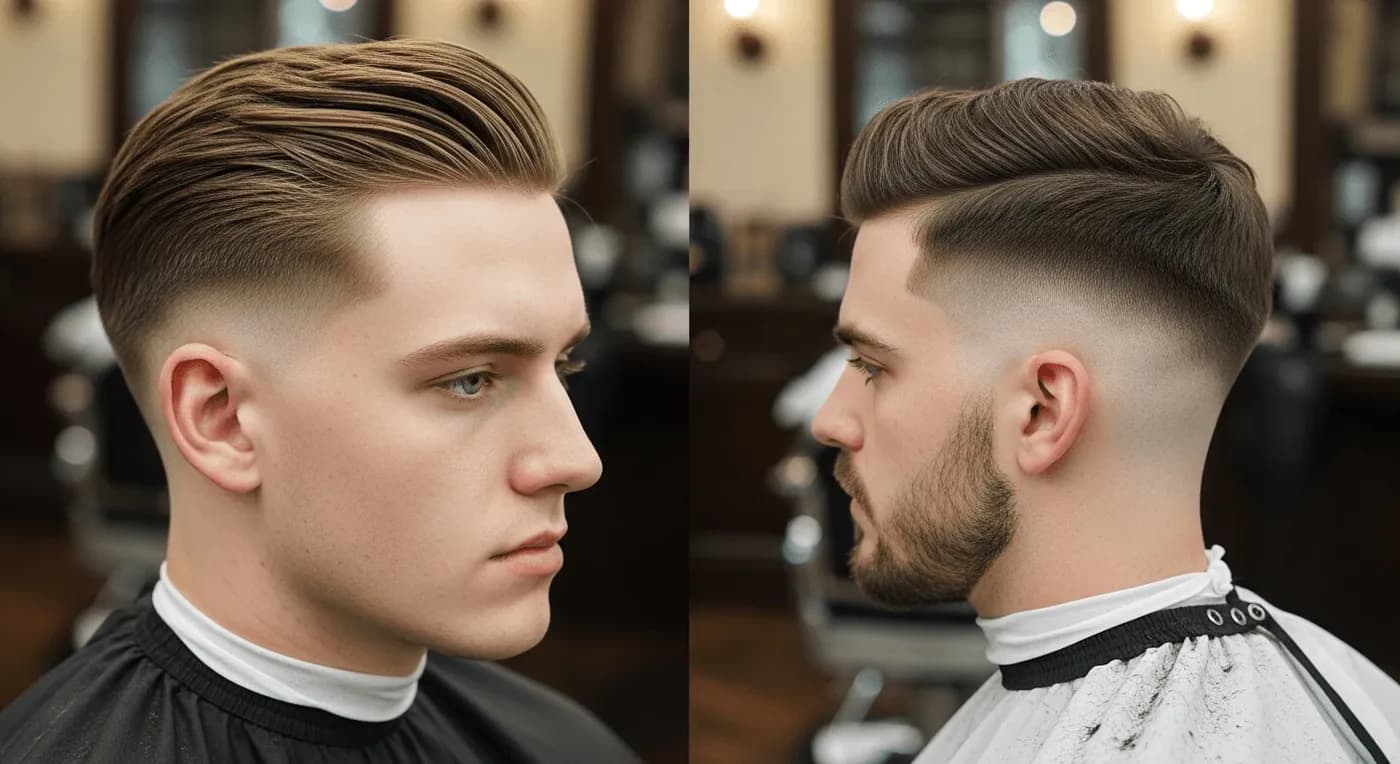
You settle into the barber's chair, the clippers humming in the background, and the barber asks the eternal question: "How do you want the blend on the sides?" In most cases, men mumble something like "Give me a fade, but not too short," or "Just a nice taper." But the truth is that most Israeli men — and quite a few rookie barbers, too — get confused between the two central terms in the barbering world: taper and fade.
The difference between a taper and a fade isn't just barber semantics; it's the difference between a classic, conservative, refined look and an urban, sharp, bold one. The wrong choice can completely change your face shape, emphasize areas you didn't want highlighted, or simply not fit your lifestyle. In this comprehensive guide, we'll sort out the terms, understand exactly what the technical and visual differences are, and help you decide which taper haircut (or fade) will best flatter your features.
In Short: What's the Big Difference?
Before we dive deep, here's the rule of thumb: every taper is a type of fade, but not every fade is a taper. Taper: A men's hair blend that focuses solely on the edges — the sideburns and the neckline. Most of the hair on the sides stays relatively full, and only the finishing touches are graduated and clean. Fade: A blend that wraps around the entire head ("360 degrees") and climbs higher above the ears. With a fade, the "fading into the skin" effect is far more dramatic and pronounced.
Men's Hair Design: The Anatomy of the Taper
When we talk about trendy men's haircuts, the taper holds a place of honor as the "safe" yet up-to-date choice. The taper is essentially the modern version of the classic businessman cut. It lets you keep enough length on the sides to slick it back, while delivering total cleanliness around the ears and neck.
If you're looking for more in-depth information on this specific style, we recommend reading the complete guide to the taper haircut for men, which emphasizes classic variations.
Who Does the Taper Haircut Suit?
The taper is a chameleon. It works great with curly, straight, or wavy hair. Its big advantage is preserving the natural contours of the head without exposing too much scalp. It's ideal for men who need to maintain a conservative dress code at work, or for anyone who wants to incorporate a full beard without creating too sharp a break between the hair and the beard (the tapered sideburns connect them perfectly).
Blend Wars: Fade vs. Taper — A Technical Comparison
To really understand who a fade haircut suits and who a taper does, we need to look at "blend height" and the level of skin exposure. In the professional barbering world, the terms "Low," "Mid," and "High" play a critical role in both categories, but their meaning differs.
Low Taper vs. High Taper
With a low taper, the blend starts right above the ear and along the lower hairline at the neck. This is the most understated look. With a high taper, the blend climbs a bit higher, but it still stays within the bounds of the "frame" and doesn't take over the entire side of the head like a fade does.
A Visual Demonstration
It's hard to explain in words the subtle nuances of scissor and clipper work. The following video does an excellent job demonstrating the precise technique that creates these smooth transitions:
Watch the demonstration on TikTok – The Barber TLV →
The Full Table: The Difference Between Taper and Fade
We've put together a comparison table to help you decide what to ask your barber for next time:
| Characteristic | Taper | Fade |
|---|---|---|
| Blend area | Targeted: sideburns and neckline only | Wraparound: the entire frame of the head (360 degrees) |
| Skin exposure | Minimal to moderate | High (especially with a skin fade) |
| Maintenance | Moderate (grows out fairly nicely) | High (needs a refresh every two to three weeks) |
| Formality level | High (suitable for a law office) | Low to moderate (depends on the height) |
| Visual effect | Classic, natural, flowing | Sharp, high-contrast, pronounced |
Matching a Haircut to a Man's Face Shape
This is perhaps the most important part. Matching a haircut to a man's face shape isn't rocket science, but it does require awareness. Round face shape: A high fade can be excellent because it removes volume from the sides and creates the illusion of a narrower, longer structure. A taper might leave too much volume on the sides and widen the face. Oblong/diamond face shape: A taper is the winning choice. Keeping hair on the sides balances the length of the face and prevents a look that's too "narrow." Square face shape: You're in luck. Both a taper and a fade will work great, depending on how much you want to emphasize the jawline.
The Future of the Blend: Burst Fade and New Trends
The barbering world doesn't rest on its laurels, and in recent years we've been seeing interesting blends between the two worlds. One of the hottest trends is the burst fade for men. This is a fade variation that creates a semicircle around the ear (like a sunburst, hence the name "burst"), while the neckline is sometimes left longer (the modern mullet style).
The burst fade combines the drama of the fade around the ears with the volume and flow of the taper at the neckline. It's a bold style that's very suitable for younger men and for anyone who wants to make a fashion statement. Want to see how it looks in real life? Here's a great place to draw inspiration from for more complex designs:
Design inspiration on Instagram – YG Hair Studio →
In Summary: Taper or Fade?
If you want a clean but non-committal look that pairs with a suit just as well as it pairs with jeans — go with a taper. If you want a sharp, chiseled look that highlights the shape of your skull and radiates urban currency — the fade is your friend.
Frequently Asked Questions (FAQ)
How often do you need to refresh a taper haircut?
Because the taper is gentler and leaves hair on the sides, it grows out fairly naturally. You can refresh it every 3-4 weeks and still look good. A fade, on the other hand, requires more frequent refreshing.
Does a taper suit thinning hair?
Absolutely. A taper can be preferable to a fade for thinning hair, since it doesn't expose the scalp as drastically on the sides, which can create the illusion of fuller hair on top.
What's the difference between a skin fade and a zero fade?
The difference is subtle but real. A zero fade uses the lowest clipper setting (with no guard), while a skin fade uses a razor or shaver to reach a level of complete skin smoothness.
How do I explain to my barber that I want a taper and not a fade?
Use the words: "I want to keep length on the sides, and just clean up the sideburns and neckline with a blend." If you say "take it down on the sides," most barbers will automatically do a fade.
Does a taper suit curly hair?
The taper is the curly-haired man's best friend. It lets you tidy up the "mess" at the edges (sideburns and neckline) while preserving the beautiful texture and volume of the curls on the sides and on top.
How much does a haircut like this cost in Israel?
The price range varies widely between neighborhood salons and upscale barbershops, but it usually ranges from 70 to 150 NIS. A taper and a fade require a high level of technical skill, so the price reflects that.
Can you do a taper yourself at home?
It's possible, but challenging. A taper requires very delicate handwork around the ears and the back of the neck (which is hard to see). A full fade is easier to do yourself (with a higher risk of mistakes) than the nuances of a taper.
Want this on your own head?
Our team at 7 Rashi St, Ramat Gan is waiting for you — booking online takes less than a minute.