Common Beard Styling Mistakes That Ruin Your Look (and 5 Instant Fixes)
Beard & Grooming9 min read

A Short, To-the-Point Intro: Why Your Beard Doesn't Look the Way You Planned
Let's get straight to the point. You're a busy urban man, probably on your way to a meeting at the financial district in Ramat Gan or wrapping up the day at the gym. You invested in a beard to upgrade your look, to add a touch of maturity and style. But something isn't working. Instead of looking sharp and professional, the beard looks messy, crooked, or just… wrong. The painful truth is that one small styling mistake can undo all your effort and turn an aesthetic asset into a visual liability. In this article we'll skip the unnecessary rambling. We'll identify 5 critical mistakes most men make, and more importantly, we'll give you practical, instant solutions to fix the situation. No wasted time, just results.
Mistake #1: The Wrong Neckline – The Optical Illusion That Ruins Everything
This is the most common and most destructive mistake. A wrong neckline is like a crooked frame on an expensive painting – it pulls all the attention away from the main subject and ruins the proportions. There are two key problems that come from positioning the bottom line incorrectly: a line that's too high, which sits too close to the jawline, creates the optical illusion of a double chin, even if you don't have one. It makes the jaw look weak and the face look rounder. On the other hand, a line that's too low that drops deep down the neck gives off a neglected, unkempt look, as if you gave up halfway. It blurs the boundary between the beard and your chest hair and creates a "wild" look in the bad sense of the word. So how do you fix it? Here's a simple, ingenious rule of thumb: stand in front of the mirror, lift your chin slightly, and place two fingers horizontally above your Adam's apple (the laryngeal prominence). The point just above your top finger is your bottom boundary line. From there, picture a gently curved line rising on both sides toward your ears. That's the line you need to shave beneath. Do it carefully, and the change in your look will be immediate and dramatic.
Pro tip: The first few times, don't rely on your eye alone. Grab a white eyeliner pencil (you can borrow one from your partner or buy a cheap one) and gently mark the contour line you've defined. This lets you shave below the line with full confidence, without worrying that you'll accidentally go too far and create asymmetry. It guarantees perfect precision and prevents critical mistakes.
Mistake #2: Trimming Too Aggressively and a Lack of Symmetry
Every beard owner knows that moment of dread: one wrong move with the trimmer, and a "hole" or "step" forms in the beard. That fear leads a lot of men to trim too much in an attempt to "fix" the original mistake, which leads to a destructive vicious cycle that ends with a beard that's too short or crooked. The most important rule here is a conservative approach: less is more. Always start trimming with a higher guard number than you think you need. If you're aiming for a length of 6 mm, start with a number 9 or 10 mm. Do one even pass over the whole beard, then reassess. It's very easy to drop the guard number and do another pass, but you can't glue back hair that's been cut. Another critical issue is symmetry, especially in the cheek lines and the mustache. A lack of symmetry, even by a millimeter, stands out a lot to the eye. To ensure straight, even lines, use natural reference points on your face. For example, set the cheek line as an imaginary line running from the corner of the mouth to the top of the ear. Make sure this line is identical on both sides. For the mustache, use the corners of the mouth or the nostrils as reference points to make sure it's straight and centered.
Mistake #3: Neglecting Basic Grooming – You're Not Washing and Nourishing It Right
Many men focus only on styling and length, forgetting that a beard is first and foremost hair and skin. Neglecting basic grooming is what separates a beard that looks good from a beard that feels good. Using regular hair shampoo on your beard is a critical mistake. Scalp shampoo is designed to deal with an oily scalp and contains harsh detergents that completely dry out the delicate facial skin beneath the beard. The result? Constant itching, red skin, and beardruff that looks bad and signals neglect. The solution is to invest in dedicated products, which aren't a luxury but essential tools of the trade.
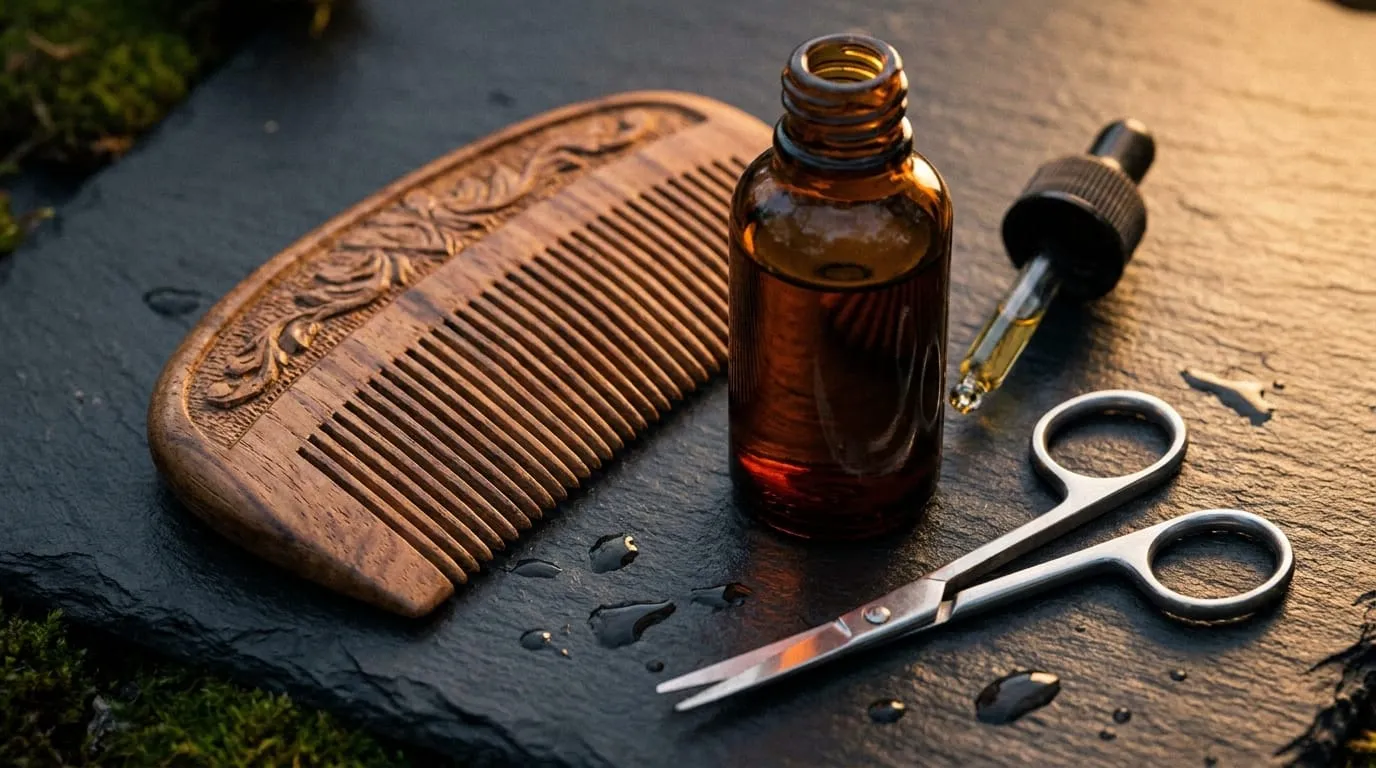
- Beard oil: This isn't a treat, it's a daily must. A few drops of quality oil after the shower work wonders. The oil nourishes the skin beneath the beard, prevents dryness and itching, softens the beard hair and turns it from bristly and prickly into soft and pleasant to the touch, and gives it a healthy shine. Think of it like a face moisturizer, only made specifically for the beard area.
- Beard shampoo: Unlike regular shampoo, it's gentler, contains natural moisturizing ingredients, and is formulated to clean the beard hair without stripping the skin of the natural oils it needs. The recommended frequency of use is about 2-3 times a week, no more, so you don't dry out the skin.
- Combing and brushing: A one-minute daily action that makes a huge difference. Daily combing with a dedicated comb (preferably wooden, to prevent static) prevents tangles and lets you "train" the hair to grow in the direction you want. Brushing with a boar bristle brush (Boar Bristle) helps distribute the skin's natural oils (and the beard oil you added) evenly along the hair, removes dead skin cells, and prevents dandruff.
Mistake #4: Ignoring Your Face Shape
Beard styling is not one size fits all. Just as a haircut needs to suit your face shape to flatter you, so does your beard. Choosing a beard style that doesn't fit your facial proportions can emphasize your flaws instead of your strengths. It's not as complicated as it sounds, you just need to understand the basic principle: the beard is a tool for optically shaping the face toward an oval shape, which is considered ideal. Here are some guidelines for common face shapes:
- Round face: The goal is to add length. Avoid a full, round beard on the sides, which will only emphasize the roundness. Instead, choose a beard that's shorter on the sides and longer around the chin (an extended "Goatee" style or a full beard with graduated length). This will create the illusion of a longer, narrower face.
- Square face: You have a strong, defined jawline, and that's an asset. The goal isn't to hide it, but to slightly soften the sharp angles. A short, well-styled beard that follows the natural lines of the face will work great. You can also keep a slightly more significant length at the chin to balance out the width of the jaw.
- Oval face: If this is your face shape, you're in luck. This shape is considered the most balanced, so almost any style will flatter you. It's a great opportunity to experiment with different beard styles, from a classic French beard to a full beard.
- Long face: Here the goal is the opposite of a round face – we want to add width, not length. A beard that's too long at the chin will only emphasize the length of the face. Instead, go for a fuller beard on the sides of the cheeks and shorter around the chin. This will help create the illusion of a wider, more balanced face.
Questions & Answers (No Rambling)
How often should you tidy up the neckline?
The short answer is once every 2-4 days, depending on your personal hair growth rate. The key to a professional, polished look is keeping the line clean and sharp. Don't wait until it starts looking neglected. A quick shave of the area every other morning is a simple habit that maintains a sharp look throughout the entire week.
My beard is patchy in a few spots, what do I do?
First, give it time. Often spots that look patchy fill in as the hair grows longer and covers them. Give your beard a chance of at least a month or two without drastic trimming. Second, daily brushing with a dedicated brush can encourage blood flow to the hair follicles and contribute to healthier growth. Third, if the patchiness is significant, consider a shorter style. A short, neat beard (stubble or a short beard) hides patchy areas much better than trying to grow a long beard that will look uneven.
Are beard balm and beard oil the same thing?
No. Although both nourish, they have different roles. Oil is liquid and its main purpose is to nourish the skin beneath the beard and soften the hair itself. It absorbs quickly and is ideal for all beard types, especially in the early growth stages. Balm has a more solid texture, like a salve, because it contains butters (such as shea) and a light wax (such as beeswax). It also nourishes, but its main purpose is to provide light styling and hold, tame unruly hair, and give the beard a more orderly shape. It's excellent for medium to long beards.
Summary: From a Problem Beard to a Professional Beard
Success in beard styling doesn't require natural talent or hours in front of the mirror. It mainly requires attention and avoiding a few basic, critical mistakes. By defining a proper neckline, adopting a conservative trimming approach, using the right grooming products, and matching the style to your face shape, you take control into your own hands. Now you have all the practical knowledge to turn your beard from a potential weak point into a true aesthetic asset. One that radiates confidence, professionalism, and style, and is ready to conquer the day. Now all that's left is to get inspired for your next style and apply what you've learned.
Want this on your own head?
Our team at 7 Rashi St, Ramat Gan is waiting for you — booking online takes less than a minute.